If You Became Disabled Tomorrow... [TRANSCRIPT]
Hello, friend! I wanted to ensure my recent Youtube video is accessible to as many people as possible. Hopefully this transcript assists!

if you were to become disabled tomorrow, I want you to know something.
You are not behind, you are not broken, and it is not too late to figure this out!
Ever, really!
You are about to enter a community that has spent decades building maps to the very things you’re navigating. And today, I’m going to hand you some of those maps, and we’re going to talk about some of the resources and advice that I would give myself if I were newly disabled again.
I’ve been a full-time wheelchair user for three years, so I made this video for the version of myself that was really scared: of what my future was gonna look like, of the fact that I had no resources, and for the version of you that might be there right now! I’m going to go ahead and provide three things, three pieces of advice… let’s go!
First up: resources.
When you become disabled, nobody hands you a folder, nobody hand you a goodie bag to tell you that this is going to be your life now; it just is.
You have to find it yourself, usually, and that can be exhausting on top of everything else that you are physically dealing with. These are what I would walk a friend through on the phone if they were to just call me tomorrow.
So, first off, I want to talk about the National Parks Service Access Pass. So if you have a permanent disability, and you live in the United states, you can actually get a National Parks pass for a lifetime free [sic] of entering them. So, I do encourage people to do this, because even though we can’t always physically hike to the top of Angel’s Landing, or, you know, do insane things inside these National Parks, the more of us that show up, the more accommodating national parks can continue to be.
But they’re actually some of the places that I have found the most peace with myself, and then a lot of the accessibility information is usually online! You just go to the entrance, you show your lifetime pass, you get in the door!
[giggles]
Super nice, and honestly awesome! It’s been great.
If you live in a country where your transportation and infrastructure is primarily car-based, like here in the U.S., there are disability placards that you can get from your doctor through your state Department of Motor Vehicles that allow you to park in the little “handicap” spots that we see outside of grocery stores, outside of public businesses, but in the United States, depending on the scale of your business, it is required for them to have those spots available for you! If you are somebody who struggles with mobility especially, I would highly encourage you to go get a placard.
Every state has its own Department of Motor Vehicles, rtules vary from state-to-state, but the general rule is, you go to your physician, your physician gets you the documentation, usually there’s a form on your DMV website to fill out, you bring that back to the DMV either by mail or by appointment, and then they send you your placard in the mail!
Goes in your car, or your caretaker’s car. I’m from Nevada originally, so my disability placard will last for ten years before I have to get it renewed again.
And then I will be able to get either two placards or a license plate; I will probably stick with the placards because I do find myself traveling a lot, so usually I like to bring my disability placard with me.
Things that nobody tells you about this: this is a regular doctor that can do it. You don’t need a specialty appointment, you just need your primary care physician.
And third resource: Mobility aids!
This section will stay short, but there will be more content on this later on. It does depend on how you consult with your doctor but the general rule in a lot of countries is that your health insurance does provide mobility aids. I would encourage you, more than anything, to advocate for yourself.
If a certain mobility situation is not working for you, for example if you were provided a powerchair, but you feel like your mobility would be a lot better, would be easier for you to get around with a manual chair, go back to your doctor!
Same thing with walkers, canes wheelchairs... the main thing is, to just advocate for yourself!
What you feel like you need is what you probably need, and your doctor might even have options that you haven’t thoguht of.
So if you keep an open discussion with your doctor about your mobility situation, about your quality of life, and get ready to advocate for what you need, you’ll be okay! I promise!
So, those are your three starting points for resources, You have my channel, which will eventually have content that breaks down mobility aids for you.
The National Parks Access pass, which I’ve gone ahead and linked down below...
I’m still bad at links, guys, I’m sorry, I’m still new to Youtube.
[laughs]
You have the National Parks Access Pass, you have the disability placard, and then you also have mobility aids, like we just discussed.
So I don’t ever want you to feel like you are a strain on the system for using resources that are made for you.
Go out, use them! Share them with people! Bring up your community!
And that brings us to our next point, which is taking care of your mental health, your wellbeing, and identity.
The biggest thing that i can recommend for that is joining the wider community!
And I’m going to go ahead and give you some ways for how to do that!
So, first of all, parasports. Seriously!
You don’t have to be necessarily active, you don’t even have to have a mobility situation that works perfectly for you yet, the main goal is just to figure out how your body moves and meet people that are in a similar situation to you!
So, walk into a room, roll into a room, find your sport, find your people--
doesn’t even matter if you like the sport! Just go to socialize! But we’re all figuring out how to live our disabled lives,
whether you are ambulatory, whether you’re a wheelchair user, we are all figuring out where we stand with parasports.
so I would highly recommend pulling out your phone, googling what parasport you wanna try, and figuring out who in your area offers it!
And if you want ideas, feel free to catch the Paralympics!
Get invgolved., Get involved wth your loal parasports communty wether you wanna pursue that professionally, whether you wanna just do that for fun to make friends, I say go for it!
I’m currently pursuing parafencing and I wanna go to the Paralympics.
I originally found it from a viral repost account when I was still ablebodied, and I remember thinking, wow! That sport is so cool! Like, I really wish that I could give it a try!
And so of course, the universe works in funny ways, and I ended up in Denver, Colorado for a doctor’s appointment for my rare disease, which my mom had take me to. I kind of had this hunch to just call around. I literally pulled out my phone, and looked up who offers parafencing in the state of Colorado.
Lo and behold, somebody did! So, I just went on down to Denver Fencing Center and as it turns out, they have a very large pair fencing program in the US that I have been so lucky to be a part of. I had to start that process myself and look things up by myself in order to find that. And yeah, it’s been pretty worth it. I’ve loved it so far.
[laughter]
So yeah, I mean, I just— I never stopped after that. And even if you do stop, you still make friends that you keep.
There’s plenty of other parasports that I’ve tried that I’ve had the privilege of keeping friends from, and honestly, it’s been one of the most
empowering experiences for me as a disabled person. Second, I’m just going to go ahead and say disabled creators on social media, not even promoting myself.
You will find creators who might be living a similar situation to you. And a lot of their goal on social media is to show their real life and what they’re living with. And so if you’re able to find someone that you gravitate towards even if they don’t have your exact disability! This really helped me in the beginning to have role models in the disabled community where I knew that a future for someone like me did exist.
Some of these examples would be Rollettes, which I actually happen to be a part of now.
I still can’t believe I’m a Rollette, you guys!
I still can’t believe I’m a Rollette!
Like actually that’s lowkey crazy. It was a really big full circle moment for me. Yeah. engage with disabled creators on social media. Or, better yet, you don’t even have to engage! Just watch. Just see what they’re up to and see what they’re doing and understand that some of these amazing things are exactly the things that you are capable of.
So, I say check them out. Figure out what your life is allowed to look like because really the possibilities are endless and there’s so many amazing people on social media that showcase that. Third, I’m going to go ahead and say online forums.
One of the ones that helped me the most was actually r/wheelchairs. That subreddit is just dedicated to talking about the mobility situation of being a full-time wheelchair user or a part-time wheelchair user or an ambulatory wheelchair user. There’s all kinds of people in there. Essentially, if you ever were to have like, in my case, questions about your wheelchair or you want to hear from people who have been wheelchair users for a lot longer, I highly recommend that one. You can also join Facebook groups for your diagnosis. I haven’t found a ton of luck with those, but I know that some people have they have support groups that are completely remote as well. I would highly recommend finding your people.
Find people who are going through similar things that you are. And again, just see what you are capable of. See what these people need help with, what you can help with, and be a part of that community. Be a part of uplifting other people. And I promise you, you will be uplifted, too. Yeah.
[laughter]
This is especially a good option for somebody who maybe isn’t comfortable publicly with their disability and doesn’t know who to ask. Go to a forum!
A lot of people are already comfortable with who they are and knowing where they’re going. And a lot of them have experienced wheelchair use for a longer than I have. So to be able to go to a subreddit, to go to a Facebook group and ask for advice has been one of the best parts about this because it’s made my experience as a wheelchair user go so much smoother. To know that I’m not alone.
And then also just to have people who know. And you don’t have to show your face. None of that. Just ask the question. Get an answer. Answer other people’s questions. Build community. Community. Four. I’m going to go ahead [again] and say watch the Paralympics.
And it’s not for the reason that you might think. It’s not because it’s inspirational. These are elite level athletes. And this is never ever ever ever something that you have to expect for yourself. I honestly do get pet peeved when people are like, “Well you do parasports, are you going to the Paralympics?
And I got to be like, “I’m trying to, but I didn’t get into it just to go. I just really like fencing.” So, instead, I’m like, “Yeah, I am, but not every disabled person is.” Back to the subject at hand. Watching the Paralympics, for me to see so many different types of disabled people on the screen doing athletic things, being regarded as athletes in their own right— was such a powerful experience for me.
And so, being able to see that there’s so many different ways to be a physically disabled human being and be athletic, be well-spoken, be out there, be yourself.
It was so incredible for me and I will be tuning in to the next Paralympics and the paralympics after that and yeah I promise so worth it. So worth it!
Last pillar and this is the one that made the most difference for me in finding myfooting again after I became physically disabled.
There was no pun intended. But I mean, granted, there’s not really any footing to be had because I’m a full-time wheelchair user. But um… that was so cringe.
Anyways, finding my footing as a wheelchair user. So, feeling comfortable in your body. How do we do that?
First of all, you need to recognize that your disability is not a burden. And so, I used to look at myself in the mirror and say, “Wow, I really do not recognize her at all. She has a body that’s a lot more high-maintenance than before. And so I had this really big phase of grief where I did not want to accept that I was actually disabled.
Once I did, it kind of opened the door to me understanding that my disability is not a burden. Now when I look in the mirror, I focus on things that make me a complete person and who I am. I look in the mirror and say, “Hey, Marley, you’re so gorgeous and you’re doing amazing today. You’re going to do amazing things.” and I go with that and I speak it out into the universe.
And even if I don’t feel it in that moment, I have the memory of telling myself that I can hold it close when I feel like my disability or my access needs are too much. But more than that, the moment that shifted it for me, if we go way back in time, actually not that far back in time, I’ve been a wheelchair user for 3 years.
When Marley first became a wheelchair user at 18 years old, I had many types of friends. I was in my first year of college and so a lot of times with friends especially at that age it’s non-committal you know we’ll go to a party together we’re in the same sorority, we’re in the same English class, so that, whatever a lot of them kind of thought, hey she’s not worth the effort anymore.
Now there are friends out there (and you are going to find them, I promise!) who have no issue accommodating you none because that’s just what you come with.
I have two amazing close friends who took the time to say, “No, you’re not a burden. Like, we love having you around and we love having you around much more than we would ever think that your disability is an inconvenience.”
Like, it didn’t even occur to them that my disability could be an inconvenience.
And that’s ideally what you want from your friends, but it’s also what you want from yourself. One day, I looked at myself in the mirror and I said, “Am I treating myself like I’m my friend?”
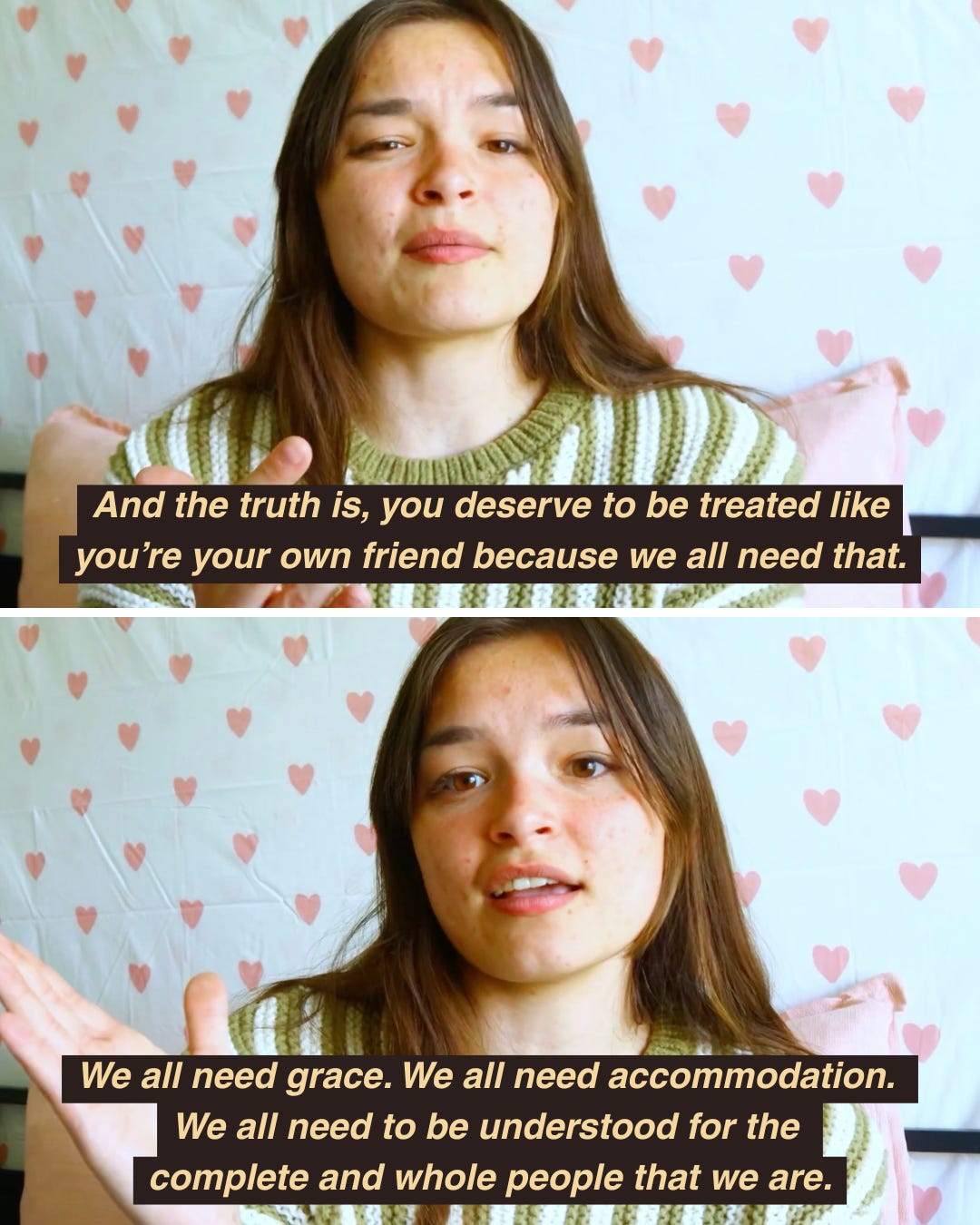
And the truth is, you deserve to be treated like you’re your own friend because we all need that. We all need grace. We all need accommodation. We all need to be understood for the complete and whole people that we are. When I started treating myself the way that my friends treated me and looking at myself the way my friends looked at me, it was a game changer.
[laughter]
And it’s been amazing ever since to be able to look at myself and say, “My disability is not what holds me back. It really isn’t anything. It’s just how I show up in the world.” And really, we don’t even have to use the B- word. I’m just going to go ahead and designate burden as the b- word. We’re not going to use it to describe ourselves with disabilities, okay? Not in the slightest. Do not do that. Actually, treat yourself like you’re a friend.
Treat yourself like somebody who deserves that because you do. Whether or not you realize it now, you deserve to be treated with love and kindness. And if you can extend the same to yourself, I promise you it will be so much easier for you to sit and accept yourself and be okay. So if you did become disabled tomorrow, here is what I would want you to walk away with from this video:
You have a path forward. You have many paths forward and many options. And you have an amazing, vibrant disabled community that has carved the way for you to be the best version of yourself that you can.
The systems you need exist and the communities you need exist. Keep in mind that there are so many incredible disabled people out there as well who are also continuing to build up frameworks that uplift us all. Truly, it’s been amazing to be able to see that there are smaller events such as Rolettes Experience, such as adaptive sport camps that you can look into that absolutely will help you build that community and find the future that you want for yourself.
The version of you that feels at home in your body may not be speaking to you yet, but I promise you that that version of yourself is real and it is something that you can absolutely work for right now. I get to do a lot of things in this life. I fence, I dance, I make art, I travel constantly.
And none of that happened because I figured everything out on my own. It happened because somebody before me built ways forward. There have been so many incredible people in the community that have come before me to make a life like I have possible and this channel hopefully becomes one of those maps.
[laughter]
So I’m hoping to share the resources that I have with you so that they get passed forward so that the community gets uplifted. And I mean yeah if this video helped you or if it helped you understand the future for somebody that you love go ahead and hit that subscribe button for me. I cover all of this more in depth across my social media channels and hopefully across this channel in the coming months if you want shorter content from me throughout the week. I’m on Instagram, too. I did link all my socials again.
Whatever brought you here, I’m so glad you came. Becoming disabled is not the end of your life.
This means that maybe a chapter closed and you’re opening a new one. And it doesn’t really have to mean anything to you. It doesn’t have to turn into a big grand inspirational story. But if you got anything out of this video, it’s that you deserve to live the life that you want for yourself, disability ornot. Hopefully, the things that I have shown you today help you to do just that.
Go forward confident, prepared, and I will see you in the next video. Love you!